

On this page
There is no defensible number, and this page is the long version of why.
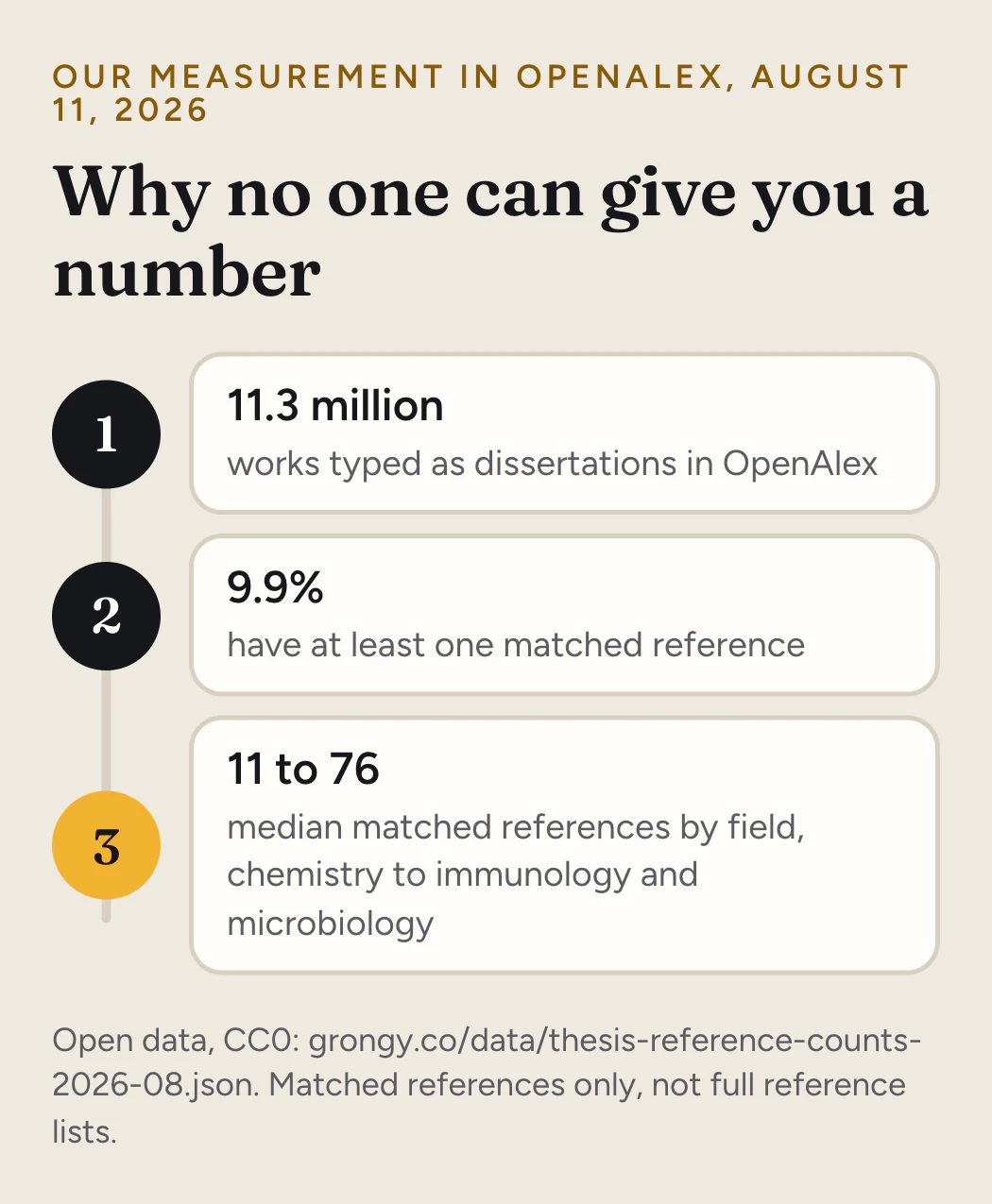
We tried to produce one. On August 11, 2026 we measured reference counts in OpenAlex for 11.3 million works typed as dissertations, and published the result as open data under CC0. It did not answer the question: 10.19 million of those dissertations carry zero matched references, so a median over the whole distribution is 0. What is left is a tenth of the corpus. Reading that tenth as "how many sources a thesis has" goes wrong twice over, and the two reasons are the useful part.
What We Measured, and What It Shows
Reference counts by work type and field: 29 segments measured August 11, 2026, downloadable as JSON under CC0. Every figure is computed over the works with at least one matched reference — a minority in every row, which is what the coverage column shows.
| Segment | Works | With ≥1 matched reference | Coverage | Median matched refs |
|---|---|---|---|---|
| Dissertations (all) | 11,303,668 | 1,118,446 | 9.9% | 32 |
| Journal articles | 196,707,730 | 78,232,742 | 39.8% | 22 |
| Review articles | 826,836 | 555,054 | 67.1% | 48 |
| Dissertations · Immunology & Microbiology | 75,930 | 9,157 | 12.1% | 76 |
| Dissertations · Biochemistry & Genetics | 443,558 | 55,900 | 12.6% | 63 |
| Dissertations · Medicine | 1,003,730 | 115,005 | 11.5% | 52 |
| Dissertations · Psychology | 405,823 | 61,939 | 15.3% | 42 |
| Dissertations · Social Sciences | 2,444,143 | 182,279 | 7.5% | 26 |
| Dissertations · Arts & Humanities | 772,428 | 61,362 | 7.9% | 19 |
| Dissertations · Chemistry | 160,689 | 15,035 | 9.4% | 11 |
Read the third column before the fourth. That is the whole point.
Why These Numbers Cannot Answer Your Question
Only a Tenth of Theses Have a Reference List in the Database at All
Those 10.19 million are not ten million theses citing nothing. They are ten million whose reference list never reached the index in a form it could use. OpenAlex documents the pipeline: references are pulled from the record's source, then matched against works the index already holds, and one reason a list comes back empty is that "many Crossref records include no references at all" (OpenAlex, Citations, updated 21 September 2026, read 25 October 2026).
That tenth is not a random sample: which repositories deposit machine-readable references and which do not is something this measurement never looked at, so nothing here is a property of theses in general.
A "Reference Count" Is Not the Length of a Bibliography
This is the more serious problem, and it is definitional rather than fixable. OpenAlex states it plainly: "Because citations are built by matching, a work's referenced_works can be shorter than the reference list printed in its PDF." It gives four reasons: the empty Crossref records above, plus a cited work that is not in the index, a source record whose references differ from the final PDF, and a reference without a DOI that failed to match on its other metadata.
So the median of 32 is not "the typical thesis cites 32 works". It is: among indexed dissertations with at least one matched reference, half have 32 or fewer. Only the second claim is in the data.
The same limit applies to the field comparison, the part a reader would quote. Arts and Humanities shows 19 and Chemistry shows 11; whether that gap is citing behavior or matching coverage, this measurement cannot separate — so "humanities theses use fewer sources" is not a conclusion it supports, and neither is its opposite.
What the Data Can Honestly Support
Two things, both narrower than the headline anyone wanted:
- The field ranking is a fact about matched references, not about citing behavior. Immunology and microbiology sits at 76 and chemistry at 11, each computed over the fraction of theses in its coverage column. Quoted without that condition, the ranking is being passed off as something else.
- Scholarly infrastructure does not capture theses. A tenth of the dissertations OpenAlex indexes have a matched reference list. Every bibliometric claim about theses, this page included, is standing on that tenth.
What Actually Determines the Number
Since the databases cannot tell you, here is what does.
Your field's citation culture. An experimental chemistry thesis and a history thesis are not comparable objects, and no ratio converts one into the other. The reliable source here is not a blog: pull five recent, passed theses from your own department's repository and count their reference lists — a figure your department has already accepted.
What your argument needs. Every claim that is not yours needs support, so the count follows from the number of claims you make. A word limit works the other way round: 2,000 words caps how much you can say about each source, not how many sources the argument needs.
Your supervisor's expectation. Field norm, institutional norm, and their own reading of both — and the only item on this list you can query directly. Ask it in a meeting and write the answer down.
The Practical Test: Saturation
The usable stopping rule is not a count. It is saturation: you stop when new searches stop changing your understanding.
In practice you are saturated when the same papers keep appearing across different search strategies; new results are mostly citing works you have already read; you can predict a paper's argument from its abstract; and the debates in your area have become familiar rather than surprising. If you are still meeting genuinely new positions, you are not finished, whatever your count says.
Signs You Have Too Few
You cite one paper per claim, so nothing is corroborated. Whole subsections rest on a single author. Your newest source predates the argument your field is having now, or your oldest is as recent as your newest — the first means you stopped reading early, the second that you have no foundation. Or nearly every source in your review cites a paper you have not read.
Signs You Have Too Many
This one gets discussed less. The tell is a review that lists rather than synthesizes: paragraph after paragraph of "[author] found X, [author] found Y", with no argument connecting them. What makes it a literature review rather than a reading list is the grouping — which studies agree, which disagree, and about what. If you cannot say what the disagreements in your literature are, another source will not supply one.
Quality Signals That Matter More Than Count
Recency balance. Both the field-defining older work and the current conversation. All-recent looks rootless; all-old looks abandoned.
Methodological range. If every study you cite used the same design, your review inherits that design's blind spots.
Disagreement. If every source in your review agrees, either the field is settled or the search is incomplete. Work out which before you write the section.
Verifiability. Every entry should be one you can open. That becomes the whole job once a chatbot has filled a gap in your bibliography: measured AI citation error rates run from 6% to over 90% across published studies, and to check AI citations is to open the source and read the sentence it was cited for.
Method Note
Data: OpenAlex API, /works endpoint, group_by=referenced_works_count, filtered by type and primary_topic.field.id, measured August 11, 2026. Percentiles are computed over works with at least one matched reference — 9.9% of dissertations — and distributions are truncated to the 200 groups the API returns, which does not affect the medians above. OpenAlex is updated continuously, so re-running this later will give different figures. The full dataset, including the segments and quartiles not shown above, is available as JSON under CC0; check it against the API before publishing from it.