

On this page
Your examiner decides. That is the whole of the University of Hohenheim's answer in its own student FAQ — four words in German ("Das entscheidet Ihr:e Prüfer:in."), where the English takes three. The question was whether a student may use ChatGPT in a final examination ("Darf ich ChatGPT in meiner (Abschluss-)Prüfung benutzen?").
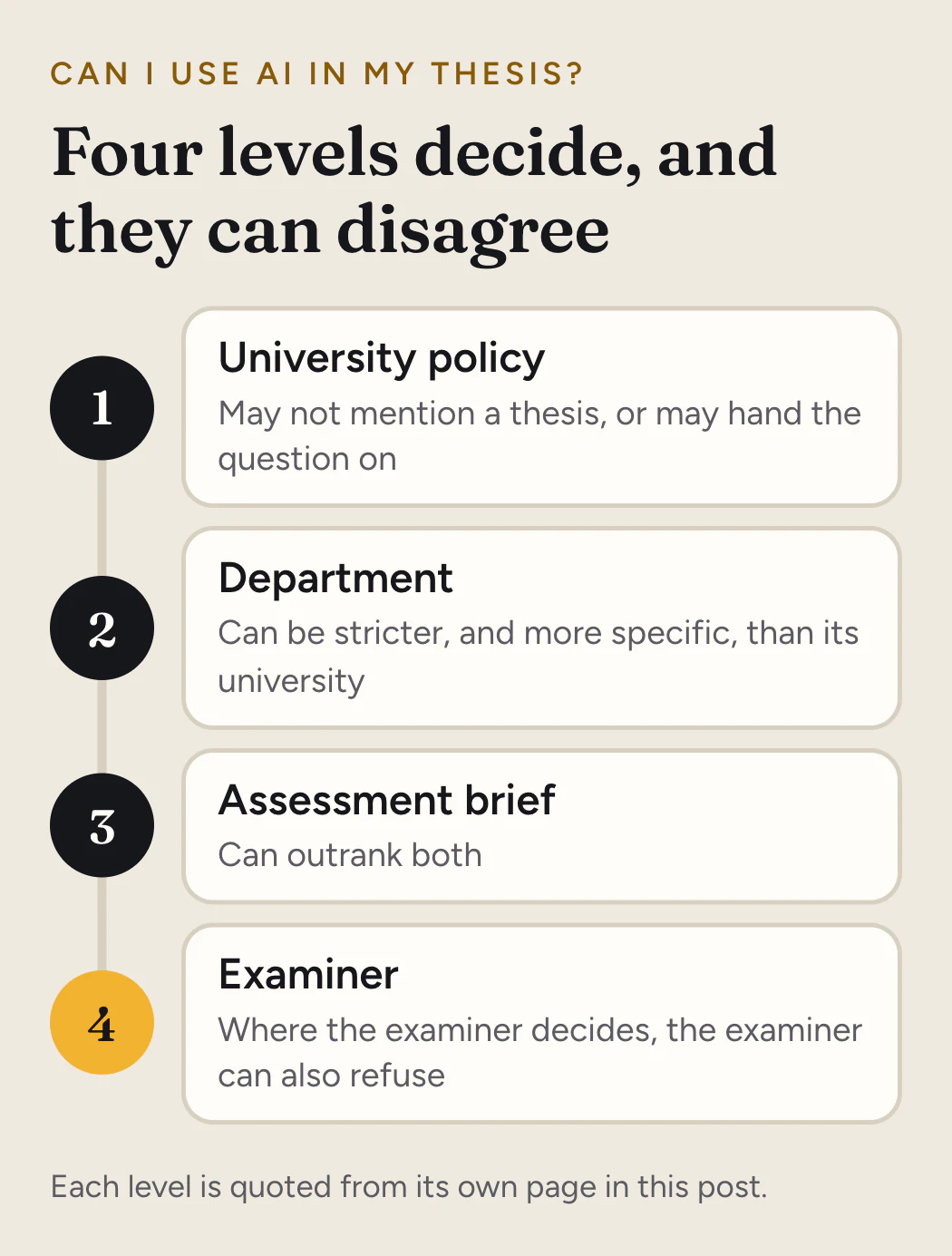
Four levels can answer whether you may use AI in your thesis: the university policy, the department's guidance, the assessment brief, and the examiner. The first three are documents; the fourth is a person. The list runs from the most general to the most local, and they do not always agree: at Hohenheim the person at the bottom outranks everything above it.
Find the level that names your own degree, note its date and section, and ask your examiner in writing when none of the four does. Every quotation below was read on October 25, 2026, and where the source page shows a date, this page gives it — a rule with no date is a rule you cannot check.
The Policy You Find First May Not Mention a Thesis
Search for your university's AI policy and you land on documents written for coursework. That is measurable, so we measured it.
On October 25, 2026, the ten search results for university ai policy in the United States were nine distinct pages: one university's guidelines page was listed twice. Together they run to 12,793 words. Between them, the words thesis, theses and dissertation appear exactly once, and that one appearance is a navigation link in a site footer rather than a sentence in any policy.
Read the first two and you see why. Columbia's Generative AI Policy runs 3,731 words and sets its own scope: it "governs the use of Generative AI tools by staff, faculty, students, and researchers (the 'Columbia community') in the performance of their functions for or on behalf of Columbia." Its student section is about classes, assignments and exams. Northeastern's Policy on the Use of Artificial Intelligence Systems, numbered 125 and issued March 31, 2025, opens on "teaching, research, and administration ('University Operations')" and then addresses somebody else entirely. Its policy section begins: "Any faculty or staff member seeking to incorporate the use of an AI System in University Operations or Outside Professional Activities must …" Neither document is wrong. Neither is written for the person submitting a thesis.
Keep going down and the pattern holds. The University of Cincinnati's AI guidelines give students three instructions, and all three point elsewhere: check with faculty members, review course syllabi, understand academic integrity. The University of Utah's guidelines page is 721 words that send you onward, to a research guideline, an approved-chatbot page, a brand guideline for marketing and communications, and a set of guidelines written from an IT perspective. Notre Dame's Generative AI Policy for Students sits inside the Undergraduate Academic Code of Honor and names the deciding party in one sentence: "Use of generative AI in a way that violates an instructor's articulated policy, or using it to complete coursework in a way not expressly permitted by the faculty member, will be considered a violation of the Honor Code."
The documents that do name a thesis sit further in: a department's guidance at Oxford, a university's examination page at Hohenheim. Almost every other sentence quoted below was written about a course assignment, which is what the nine pages publish rules about. It is the finding, not a flaw in the search: the level that names your thesis sits below the level that publishes a policy, and the work is to go down to it.
One note on the word itself, because it decides what you type into the search box. Oxford's materials department requires a statement in the student's thesis, and then, in its own worked example, promises that AI was not used to "write unrevised dissertation sections." The same department uses both words for the same document. Hohenheim's rule covers Abschlussarbeiten, the final theses of a degree program. This page says thesis throughout and means any final research-degree document; if your regulations say dissertation, search for dissertation.
Work Down the Four Levels Until One Names Your Thesis
The University Policy May Pass the Question Down
Some university-level documents say plainly that they do not decide. The University of Arizona's AI guidelines and principles say it outright: "While there is currently no single, university-wide policy specific to AI, instructors are encouraged to set clear expectations in their course materials." For students the rule follows from that: "You may only use AI tools for class assignments if your instructor has explicitly approved their use."
Others set a frame and name its edges. The University of Edinburgh's guidelines for students, carrying a revision date of March 2026, say "The University does not ban the use of AI, though its use will be restricted for much of your assessed work," and add that "some of your courses may also restrict its use in other ways."
Cambridge's Educational Policy Office page, which shows no date, draws its line not at the tool but at the kind of work. Practice and study sit on one side, and there the answer is yes: "Students are permitted to make appropriate use of artificial intelligence tools to support their personal study, research and formative work." Graded work sits on the other: "A student using any unacknowledged content generated by artificial intelligence within a summative assessment as though it is their own work constitutes academic misconduct, unless explicitly stated otherwise in the assessment brief."
Notice the last clause. The university has just told you which document outranks it.
Sector-wide statements sit outside the four. The Russell Group's principles on the use of generative AI tools in education, dated July 3, 2023, commit the group's members to "ensure academic rigor and integrity is upheld," note that "clear and transparent policies are critical," and say students should be able to discuss their AI use "openly and without fear of penalization." These describe what a group of universities promises to do. They do not tell you what your degree permits.
The Department's Guidance Can Be Stricter, and It Can Be More Specific
Cambridge shows the gap inside one institution. Against the university policy quoted above, the Department of History and Philosophy of Science writes on its academic misconduct page that "HPS prohibits students from presenting text, ideas and other material generated by AI tools as their own work," and that "HPS will not distinguish between the input of AI and the input of another human being in drawing the line between permissible help and plagiarism." HPS students also hand in a cover sheet with graded take-home work. Neither page shows a date.
Being stricter is one way a department matters. Being more specific is another, and it is the one that produces instructions you can follow. Oxford's Department of Materials, on its generative AI page for postgraduate research students, tells its doctoral and research-master's students what the thesis itself has to contain: "All DPhil and MSc(Res) students in materials must include in their thesis a statement on their use of generative AI." The statement goes "immediately after the abstract" and "must include a formal declaration that any generative AI use complies with university, divisional and departmental guidance." The page sets a floor for the detail: "As a minimum this should for each different usage case list the name, version and publisher of the generative AI tool."
Its worked example, signed off "AJW 28/05/2026," shows what that looks like filled in. It lists Claude 4 Sonnet from Anthropic, used "to discuss possible structures for the methodology chapter"; Elicit from Ought, used "to assist in locating potentially relevant literature for screening"; and ChatGPT twice, once to compare notes across papers and once to translate legacy Fortran into Python. It then states what was not done: "AI tools were not used to fabricate references, generate experimental data, conduct statistical analysis autonomously, or write unrevised dissertation sections." On data it says "No confidential, commercially sensitive, or participant-identifiable data were entered into public AI systems."
Arizona keeps a list of its departments' guidance and explains why: "many colleges and departments have developed additional guidance tailored to the unique needs of their disciplines." If your university keeps such a list, that is the page to find before you read anything else.
The Assessment Brief Can Outrank the Two Above It
King's College London puts the decision in the document you were handed with the task. Its university-level AI guidance, last updated April 2025, says "King's staff are encouraged to review their assessment briefs and to ensure clarity around acceptable use in that documentation," and that this can happen at "programme, module or individual assessment level." Students then append one of two statements. The first begins "I declare that no part of this submission has been generated by AI software." The second says the submission contains contributions from AI software and "aligns with acceptable use as specified as part of the assignment brief/guidance" — the same document this page calls the assessment brief.
Read the second one closely. It does not declare that the use was permitted by the university. It declares that the use matches a brief, which means the brief has to say something. If yours says nothing, that declaration has nothing to point at — and a silent document has a rule of its own, written somewhere you have not looked yet. If your thesis came with no brief at all, this level is empty for you and the decision falls to the next one down.
The Examiner Can Permit, and the Examiner Can Refuse
Hohenheim states the arrangement in full. Its page on generative AI in examinations says the Senate's recommendations apply to examinations registered from October 1, 2023, and that generative AI systems may in principle be used as an aid in unsupervised written work, final theses included, provided the use does not defeat the purpose of the examination ("dürfen grundsätzlich als Hilfsmittel bei unbeaufsichtigten schriftlichen Prüfungsleistungen wie Hausarbeiten, Seminararbeiten und Abschlussarbeiten eingesetzt werden, sofern ihr Einsatz nicht dem eigentlichen Zweck der Prüfung entgegensteht"). The next sentence moves the decision down, to the discretion of the individual examiner or module leader ("Die Entscheidung darüber liegt im Ermessen der jeweiligen Prüfer oder Modulverantwortlichen"). Your supervisor counts at this level only if your supervisor is also your examiner.
The page's FAQ for teaching staff asks whether they may prohibit AI in their examinations, and the answer is yes ("Ja"). The same FAQ tells staff to inform students of the decision. The FAQ for students adds a detail to copy: if you are unsure whether a piece of software counts as generative AI and has to be declared, ask your examiner ("wenden Sie sich an Ihre:n Prüfer:in"). And one more that is easy to miss. Submitting the AI declaration does not replace the ordinary declaration of independent work, which you still have to hand in as well ("Sie müssen in jedem Fall noch zusätzlich eine Eigenständigkeitserklärung abgeben").
The University of Koblenz publishes principles and then passes the paperwork down. Its page on AI in study and teaching states that AI use has to be disclosed ("Die Nutzung von KI-Systemen muss offengelegt werden"), that outputs must be documented in a form someone else can follow and must not be passed off as independent intellectual work, and that users carry full responsibility, because an AI system cannot carry liability ("Ein KI-System kann keine Haftung übernehmen"). Its declaration templates are described on that page as models for institutes and departments to finalize ("Muster für Institute und Fachbereiche"). The university wrote the form. Someone else fills in what it permits.
Stanford and Harvard write about course instructors; for a thesis, the same slot is held by your examiner. Stanford's Board on Conduct Affairs guidance, dated February 16, 2023, says the same thing from the other end: "Individual course instructors are free to set their own policies regulating the use of generative AI tools in their courses, including allowing or disallowing some or all uses of such tools." Harvard's guidance for faculty assumes the variation and prepares for it. It states that "All faculty are required to inform students of the policies governing generative AI use in class," then offers three sample syllabus statements. One reads "We specifically forbid the use of ChatGPT or any other generative artificial intelligence (AI) tools at all stages of the work process." Another reads "This course encourages students to explore the use of generative artificial intelligence (GAI) tools such as ChatGPT for all assignments." A third says "The default is that such use is disallowed unless otherwise stated." A student could meet all three statements in a single term at a single university, under one posted AI policy.
Two Universities Read the Same Silence and Set Different Defaults
Here is the case the top of the search results cannot cover, because every page there speaks for one institution and the comparison needs two.
Stanford and Columbia both wrote a sentence for the situation where nobody has said anything. Both sentences begin with the same eight words.
Stanford: "Absent a clear statement from a course instructor, use of or consultation with generative AI shall be treated analogously to assistance from another person."
Columbia: "Absent a clear statement from a course instructor prohibiting the use of generative AI tools to complete an assignment or exam, students should reach out to their instructors for guidance regarding use of AI tools to support their learning."
Stanford classifies the silence: the use is placed in a category that already existed, assistance from another person, and judged by whatever rule governs that category. Columbia does not classify it; the policy sends you to ask, and reserves its consequence for the case where an instructor has already prohibited the tool: then "the unauthorized use of AI shall be treated similarly to unauthorized assistance and/or plagiarism."
The same silence produced two different defaults. Stanford's page carries February 16, 2023. Columbia's page carries no date at all, while telling readers that "this guidance will evolve and be updated regularly" and that the policy "may be updated from time to time."
A silent document does not mean you are free, and it does not mean you are barred. It means the defaults have already been written, and you have to find out which one applies to you. While you are looking, Stanford's is the default you can apply on your own, without waiting for a reply: treat an AI tool the way help from another person is already treated. If it would be improper to ask another person to do a piece of your work, it is improper to ask the tool to do it. Stanford wrote that rule down; your institution may not have. That rule is Stanford's, not yours, and it does not protect you if yours says otherwise. Use it until you find yours.
If you are reading this because you have already been accused, that is a separate problem with separate evidence, and our post on being falsely accused of using AI deals with it.
When a Policy Comes With a Color
Twice in the documents read for this page, a body stopped writing prose and drew a scale instead. Both scales tell you something a paragraph does not: that one person chooses.
The University of Arizona offers its instructors "sample syllabus language based on a Red-Yellow-Green model, which outlines whether AI is prohibited, allowed with permission, or actively encouraged." The model gives an instructor three paragraphs to choose from, and the instructor chooses. If your thesis came with no syllabus, the same mechanism leaves you with a person to identify and no document to read.
Springer Nature uses the same device for authors rather than students, on its AI guidance for researchers, editors and reviewers. Its three bands are labeled "Green - Permitted" for "Assistive AI use," "Amber - Exercise caution" for "Evaluative or interpretive AI use," and "Red - Not permitted" for "AI replacing scholarly judgement or lacking transparency." The middle band is "Amber" rather than yellow, which is the clue that these are two separate scales and not one standard. The page shows no date.
Arizona and Springer Nature are not in the same business, and they reached for the same device. Across the nine pages that ranked for university ai policy, exactly one named a scale like this. Where a scale exists, your question narrows to something answerable: who picked the color for your work, and where did they write it down?
What Counts as AI Use, and Who Answers That
If your question is about a grammar checker, use the rule of the body you are submitting to, because they differ.
Elsevier's policy on generative AI in writing, updated July 2026 as shown on the page, says plainly: "Basic checks of grammar, spelling and punctuation need no declaration."
Springer Nature's author guidance says, in its body, "The use of an AI tool for 'AI assisted copy editing' purposes does not need to be declared." Its FAQ, lower down the same page, says "The use of an LLM (or other AI-tool) for 'AI assisted copy editing' should be declared in line with our AI guidance." Both sentences were on the page on October 25, 2026. One page, two answers.
Hohenheim does not try to define the edge; it tells you who to ask. The page describes generative AI as software that uses statistics on its training data to produce new material that resembles it, gives ChatGPT as an example, and then tells students that if they cannot tell whether a given piece of software counts, they should ask their examiner. The question "does this count?" is a question for your examiner, not for a search engine.
Oxford Materials, Hohenheim and Koblenz want the same thing from you in different words: a record. Oxford Materials wants the name, version and publisher of each tool and what each was used for. Hohenheim wants a statement of which system was used at which stage of the work, and calls it a tool for your own reflection as much as information for the examiner. Koblenz wants a record of what the tool produced, in a form someone else can follow. None of that can be reconstructed at submission from memory, which is the practical argument for writing it down as you go. Whether an undisclosed use also counts as plagiarism is a different question; we draw that line on our page on academic integrity and AI.
Four Questions, and the Level to Send Them To
Send these before you write, not before you submit. Ask for a reply by email, so the answer exists in writing. Question one is first on purpose: it establishes which level governs, and the other three change meaning depending on the answer.
Subject: AI use in my thesis: four questions
Dear Dr [Name],
Before I go further with [chapter or stage], I want to be sure I am following the right rule. Could you answer the four questions below by reply, so that I have your answers in writing?
- Which level governs AI use in my thesis: the university policy, the department's guidance, the assessment brief, or your own decision as my examiner? If more than one applies and they differ, which one wins?
- Within that level, which tasks are allowed and which are not: literature searching, outlining, language editing, coding, data analysis, drafting text?
- May my data (transcripts, survey responses, interview notes) go into any AI tool, and does my ethics approval need an amendment first?
- If I later turn chapters into journal articles, does your answer still apply, and who decides if a question comes up at the examination?
Thank you,
[Your name]
If the reply says the university policy allows something your supervisor does not, follow the stricter of the two and keep the correspondence. At Hohenheim the examiner's word is the rule, so a supervisor who is also your examiner has settled it. At an institution that has not delegated that far, the same email settles less.
A Fifth Level Appears If Your Chapters Become Articles
This level is conditional. It arrives only when you submit for publication, and it answers to none of the four. None of the nine pages that ranked for university ai policy mentions Elsevier, Springer Nature or the International Committee of Medical Journal Editors, and if your chapters are going to become articles, that omission matters: the statement you wrote for your examiner is not the one an editor will ask for.
Elsevier says "AI Tools should always be applied with human oversight and control" and "Ultimately, authors are responsible and accountable for the contents of their work." Disclosure goes in a section titled "Declaration of Generative AI and AI-assisted technologies in the writing process." On images Elsevier is explicit where nothing quoted here from a university says anything at all: it "does not permit the use of generative AI or AI-assisted tools to create or alter images in submitted manuscripts," with an exception where such use is part of the research design and is described in the methods.
Springer Nature gives the reason in two sentences: "AI is a tool and cannot be held accountable. Thus, authorship and other tasks requiring accountability can only be performed by a human." Where the declaration goes is less settled. The guidance body says "The use of generative AI tools should be declared in the Introduction or Acknowledgements of the manuscript." The FAQ on the same page says such use "must be documented in the manuscript's Methods section (or equivalent) or for book authors in the acknowledgements, introduction of preface [sic] of the manuscript." The same page therefore names four different places for one declaration.
The ICMJE recommendations on AI use by authors, which show no date, ask authors to "describe, in both the cover letter and the submitted work in the appropriate section if applicable, how they used it." Chatbots "should not be listed as authors because they cannot be responsible for the accuracy, integrity, and originality of the work." Two further lines belong in the thesis itself: "Referencing AI-generated material as the primary source is not acceptable," and "Nondisclosure of AI use may require corrective action and may be construed as misconduct in some circumstances."
On one failure these bodies converge, and none of them uses the others' words for it. Oxford Materials' example statement promises that "AI tools were not used to fabricate references." Springer Nature's manuscript guidelines for books warn that AI models have been known to create false information "such as fabricating references." The ICMJE rules out AI output as a primary source. The size of that failure is the subject of our post on AI citation error rates.
What This Page Cannot Tell You
It cannot tell you whether you are allowed. The documents quoted here are other people's rules. At Cambridge, a student in History and Philosophy of Science is covered by two of them at once, the university policy and the department's guidance, and they do not say the same thing. A student at an institution not quoted here is covered by none of them.
It can show you that this ground moves, using its own history. When this post was first written on September 29, 2026, Springer Nature's book guidelines said "We do not accept AI models, such as ChatGPT, as authors of content in Springer Nature books." On October 25, 2026, that sentence was no longer on the page, and the word "ChatGPT" did not appear anywhere on it. In its place the guidelines set out refusals: "We do not permit: AI-written content that has been reproduced without any human verification" and "Deepfake or photorealistic AI-generated or manipulated image, audio, or video content that resembles real persons, objects, places, entities or events." Of the links that first version used, three redirected elsewhere on the same date.
So the date on the page you are reading, including this one, is part of what it tells you. Check the date on yours, and when it shows none, record that too. Supervisors, librarians and program leads who want the institution's side of the same arrangement can start from our page for universities.
Frequently Asked Questions
Can I use AI to write my thesis?
Only the level that governs your degree can answer that, and it is not always the university policy. Four levels can answer it: the university policy, the department's guidance, the assessment brief, and the examiner. Cambridge permits appropriate use for personal study, research and practice work, and treats unacknowledged AI content in a graded assessment as misconduct unless the assessment brief says otherwise. Hohenheim permits it in principle for final theses and leaves the decision to the examiner, who may refuse. Edinburgh does not ban it but restricts it for much of the assessed work. Oxford's materials department permits it and requires a statement naming each tool, its version, its publisher and what it was used for. Find your level, then ask in writing.
Nobody has told me anything. Does that mean yes?
It means a default has been written somewhere. Stanford's default is that AI use without a clear statement from the instructor is "treated analogously to assistance from another person." Columbia's default is that you should contact your instructor for guidance. Those are different instructions from the same silence, so find out which default is yours before you rely on either.
My supervisor says yes but the university policy says no. Which do I follow?
Follow the stricter one until someone with authority over the policy says otherwise, and ask your supervisor to point to the text or to the person with authority over it. Keep the reply. Where the examiner holds the decision, as at Hohenheim, a supervisor who is your examiner has answered it; elsewhere the same reply carries less weight.
Do I have to declare a grammar checker?
Use the rule of the body you are submitting to, because they differ. Elsevier says "Basic checks of grammar, spelling and punctuation need no declaration." Springer Nature's author guidance answers the same question twice on one page, once with no and once with yes. Hohenheim tells students to ask the examiner when they cannot tell whether a tool counts.
Does declaring it make a prohibited use acceptable?
No. Koblenz sets two duties: AI use must be disclosed, and AI output must not be passed off as independent intellectual work. Meeting the first does not meet the second, and neither one creates a permission you did not have. The ICMJE adds a third problem: nondisclosure itself, which "may require corrective action and may be construed as misconduct in some circumstances."
Sources
Every page below was read on October 25, 2026, the day this page was last revised. The date shown on the source page itself, where there is one, is in parentheses.
- Columbia University, Office of the Provost, Generative AI Policy (no date shown)
- Elsevier, Generative AI policies (updated July 2026)
- Harvard, Office of Undergraduate Education, Generative AI guidance for faculty (no date shown)
- ICMJE, Artificial intelligence: AI use by authors (no date shown)
- King's College London, Macro-level: university-wide principles and policy (last updated April 2025)
- Northeastern University, Policy on the Use of Artificial Intelligence Systems, Policy 125 (issued March 31, 2025; no revision date shown)
- Russell Group, Principles on the use of generative AI tools in education (July 3, 2023)
- Springer Nature, AI guidance for researchers, editors and reviewers (no date shown)
- Springer Nature, Manuscript guidelines for books (no date shown)
- Stanford University, Board on Conduct Affairs, Guidance and recommendations (February 16, 2023)
- Universität Hohenheim, Einsatz von generativer KI in Prüfungen (applies to examinations registered from October 1, 2023)
- Universität Koblenz, KI in Studium und Lehre (no date shown)
- University of Arizona, AI Guidelines & Principles (no date shown)
- University of Cambridge, Educational Policy Office, Artificial Intelligence (AI) (no date shown)
- University of Cambridge, History and Philosophy of Science, Academic misconduct (no date shown)
- University of Cincinnati, Guidelines on AI use (no date shown)
- University of Edinburgh, Using generative AI in your studies: guidelines for students (revision March 2026)
- University of Notre Dame, Generative AI Policy for Students (August 2023, per the page title)
- University of Oxford, Department of Materials, Generative artificial intelligence (example statement signed May 28, 2026; guidance updated from May 2026)
- University of Utah, Guidelines & Policies (no date shown)