
On this page
You wrote it. A score says otherwise, and now there is a meeting on your calendar.
The argument is not about whether detectors work. Turnitin's own documentation says the percentage "should not be used as the sole basis for action," and that below 20% its report prints no score at all. So there are three things to do, in this order: find out what the score is a score of, ask for the report that produced it, and put the revision history of the work in front of the professor.
What Your Percentage Is a Percentage Of
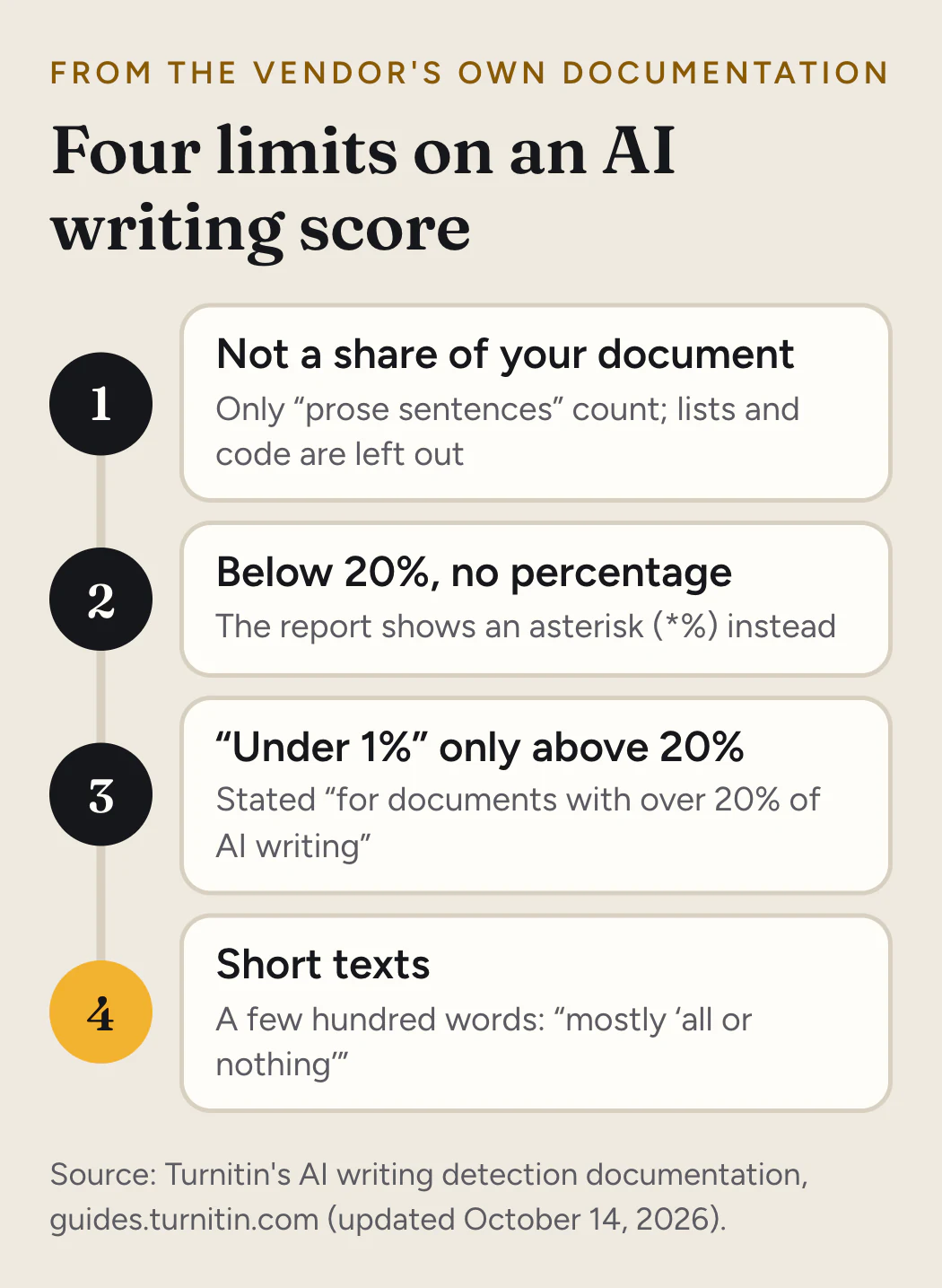
The first of the three starts here. If the score you were shown came from Turnitin, its own documentation puts four limits on it, on a page timestamped October 14, 2026, which makes it the vendor's current position and not its 2023 one.
It is not a share of your document. The score covers "the amount of qualifying text within the submission," and qualifying text means "only prose sentences." In Turnitin's words, "This percentage is not necessarily the percentage of the entire submission." A score of 40% is 40% of a subset nobody has shown you the size of.
Below 20%, the report prints no score at all. This is the limit you can check for yourself. Turnitin's documentation says that to avoid false positives, "no score or highlights are attributed for AI detection scores in the 1% to 19% range," and that below the 20% threshold the report "is now indicated with an asterisk (*%) and no percentage is attributed." So if the score you were quoted sits under 20% and was attributed to Turnitin's AI writing indicator, ask where it came from, because the current report does not produce it.
The "less than 1%" claim has a condition attached. The vendor's current version of that claim reads: a false-positive rate kept "under 1% for documents with over 20% of AI writing." It is scoped to documents already scoring above the threshold, and it is not a statement about every paper that goes through the system.
Short texts behave differently. "In shorter documents where there are only a few hundred words, the prediction will be mostly 'all or nothing'," the documentation says, "because we're predicting on a single segment without the opportunity to overlap." Mixed text, it says, "could be flagged as entirely AI-generated." OpenAI reported the same shape of problem with its own tool, which was "very unreliable on short texts (below 1,000 characters)."
The Score Was Never Meant to Decide This
"It should not be used as a primary decision-making tool, but instead as a complement to other methods of determining the source of a piece of text."
That is OpenAI, writing about its own AI classifier in a post dated January 31, 2023. On its evaluation of a "challenge set" of English texts, the classifier caught 26% of AI-written text and labeled 9% of human-written text as machine-made. A note now sits at the top of that page: "As of July 20, 2023, the AI classifier is no longer available due to its low rate of accuracy."
"The percentage on the AI writing indicator should not be used as the sole basis for action or a definitive grading measure by instructors."
That is Turnitin's own guidance, updated October 14, 2026. The same page says the company "does not make a determination of misconduct, rather it provides data for the educators to make an informed decision." The company's second document is older and blunter. In a post dated March 16, 2023, Turnitin's chief product officer Annie Chechitelli had written, "If the evidence is unclear, assume students will act with integrity."
"the AI detectors don't prove anything, they just analyze probability"
That is from the faculty guide published by Hope International University's Darling Library, on its page AI Talks - When a Student Denies Use, last updated on October 16, 2026. The sentence it sits in goes further: unless the professor takes the student's computer and inspects the browser history, revision history, and cache, the guide says, "you have no way to 'prove' that the student used AI."
Three parties, four documents, and not one of them treats the score as a finding. If it is being treated as the finding in your case, that is the thing to say — in the vendor's own words.
Ask for the Report, Not the Number
The second of the three is a request for a document students do not get by default.
Turnitin's documentation states that "the AI writing detection indicator and report are not visible to students." Then it states the exception in the next sentence: "with the PDF download feature, instructors can download and share the AI report with students."
So the request is narrow. Ask for the downloaded AI writing report as a PDF — the report, not the score. Then you can see which sentences were highlighted and whether the indicator carries a percentage or an asterisk. The same page lists the processing requirements you can check it against: at least 300 words of prose in a long-form format, no more than 30,000 words, and English for the English-language model to run at all.
Ask in writing, ask before the meeting, and ask for the response deadline at the same time. If a deadline has already been set and you need longer to collect documents, request the extension before it passes.
One Institution Wrote Down the Questions Your Professor May Ask
On October 25, 2026, the ten results a US search returned for falsely accused of using ai included one university page — and it was not addressed to students. It was Hope International University's faculty guide, and two of its pages are a script for the conversation you are about to have.
The guide marks itself a work in progress and names one librarian as its author, so it is one institution's thinking and not a sector standard. Read that way, it still tells you what the meeting is for.
Its page AI Talks - When a Student is Suspected opens with a question rather than an accusation: "Do you have a guess as to why we are having this conversation?" The bracketed instruction to the professor — "And then let them stew" — is a stage direction, not a verdict. On the score itself, the advice is explicit: "Don't tell the percentages because those are just numbers based on probability and not very accurate." If nobody shows you a score, this is one documented reason why.
Then come the requests, in roughly this order:
- Your revision history. "Can you open your paper on your computer? I'd like to see if we can go over your 'revision history'." The note beside it tells the professor to ask why, if the document has no history.
- Your notes and sources. "Do you have any notes or articles that might have your writing on them?" The note beside that one is blunter: a student who cannot produce notes or sources invites more suspicion, not less.
- What tools touched the text. Translation software, then Grammarly, Word, and Google Docs, then rewriting sites, each asked about separately.
The guide also draws a line that matters for how precisely you answer: "Misspellings corrected will not cause a detector to flag a paper. Rewording sentences by the AI will cause flags." Those are different acts, and lumping them together in a hurry is how a true answer starts to sound evasive.
And on the denial page, the guide says what it is ultimately reaching for when no proof exists: "the only real option is to get a confession out of the student." It describes three appeals for getting one, to the student's fear of punishment, to their future career, and to their character, with a warning to the professor not to open with the first, since a student who realizes there is no proof may stop talking.
The sequence is the useful part, because none of it arrives as a surprise. Answering in writing, with the revision history attached, is one thing you can offer instead of answering on the spot. You are not reading a transcript of your own meeting. You are reading what one institution thinks that meeting is.
Who Gets Flagged, and What the Measurements Show
One measurement is specific about who it is about. In Patterns in July 2023, Weixin Liang and four colleagues at Stanford University reported their own test: seven GPT detectors run on 91 TOEFL essays written by non-native English speakers and 88 essays by US eighth-graders (doi:10.1016/j.patter.2023.100779). The detectors classified the US student essays accurately. On the TOEFL essays they "incorrectly labeled more than half" as AI-generated, at an average false-positive rate of 61.3%. All seven agreed on 19.8% of those human-written essays, and at least one detector flagged 97.8% of them. Their recommendation is addressed to institutions and not to you: they "strongly caution against the use of GPT detectors in evaluative or educational settings, particularly when assessing the work of non-native English speakers."
One faculty guide names the people it expects this to hit. Hope International University's When a Student Denies Use page says that "English language learners, STEM students, and students on the Autism spectrum will be falsely flagged more than they should be." The guide attaches no rate to that sentence; the paper above measured only the first of those groups, and only on TOEFL essays.
Reshaping your own writing now, to move a score, is the one move you genuinely cannot defend: it comes after the accusation, and it is indistinguishable from concealment. The warning belongs here because the same paper tested the mechanism. Rewriting the TOEFL essays with a richer vocabulary dropped the average false-positive rate from 61.3% to 11.6%, and simplifying the vocabulary of the eighth-grade essays pushed their misclassification up. That measures what the tools respond to, which is word choice. If richer or plainer prose is simply how you write, or you rewrote for clarity long before any of this started, that is your writing, and the answer is the record of how it was made, not a change to the text now.
Two lists of causes sit beside the research, each written by a party with first-hand access to the problem. Turnitin's documentation says false positives "can include content without a lot of structural variation, text that literally repeats itself, or text that has been paraphrased without developing new ideas." Hope International University's AI Detectors page names four: formulaic writing; English language learners "writing generic 5 paragraph essays AND using translation tools"; translation tools themselves; and students who "'correct' all their grammar and spelling 'errors' with Word, Google Docs, or Grammarly." Neither list carries a rate, which is also why neither can tell you whether it explains your case.
In 2023, one institution did the arithmetic itself and published it. On August 16, 2023, Vanderbilt University disabled Turnitin's AI detector "for the foreseeable future," and its reasoning took the vendor's 1% figure and multiplied it: "Vanderbilt submitted 75,000 papers to Turnitin in 2022," so "around 750 student papers could have been incorrectly labeled." What it multiplied was the unconditional version of that figure, the one the vendor was publishing in 2023, not today's version scoped to documents above 20%. The arithmetic held against the claim as it stood then, and we make no claim about where that decision stands now.
Bring the Revision History, Not an Argument About the Score
The two checks above are things you can verify tonight. This is the third, and the thing you carry into the room.
A revision history is a record, and the guide quoted earlier asks for it first. So put it in front of the professor without waiting to be asked:
- Your revision history, with timestamps. Google Docs version history, Word's versions, a version-control log if you use one, and dated file copies — whatever your tools actually kept.
- Reading notes and annotated sources. Marked-up PDFs with your comments on them carry more weight than clean ones, because a clean copy shows nothing about how it was read.
- Earlier drafts and the mess in them. Deleted paragraphs, a wrong turn you abandoned, a paragraph you rewrote four times. A clean trail of one perfect draft is the weaker trail.
- Correspondence. Emails to a supervisor, a comment thread on a shared draft, and a question you asked in a seminar.
- A short written chronology. One page, in date order, saying what each item shows. Hand it over instead of narrating it.
Then be exact about the tools you did use, and be exact the first time. A grammar checker, a translation tool, and a model rewriting your sentences are three different acts, and the guide treats them differently. An account that starts as "I didn't use anything" and becomes "well, only for grammar" after the second question reads as concealment even when it is not.
Two more things. Do not delete, re-save, or tidy any file connected to the submission; the revision history is your evidence, and altering it is a separate problem. And if any reference in your bibliography came out of a chat tool instead of a paper you opened, check AI citations before the meeting — a reference that resolves to nothing is a finding that needs no detector.
The Rule That Decides Your Case Is Your Institution's
Nothing on this page is binding anywhere. The document that governs your situation is your own institution's, and three questions are worth answering before you walk in: whether a detector score can stand as evidence on its own or only open an inquiry, who decides, and how long you have to respond or appeal.
Find it in the course syllabus first, then the student handbook, then the academic integrity procedure, and read the version in force for the term the work was submitted. Whether you can use AI in your thesis at all is a separate question, and one worth settling before the next deadline.
And if what you actually did was run a grammar checker or a translator over your own sentences, the question in front of you is not detection. It is whether using AI is plagiarism under your own regulations, and that is the question to put to whoever wrote them; our page on academic integrity and AI sets out where we draw the line.
A score is arguable. A record of the work is not.
Frequently Asked Questions
Can I be failed on a detector score alone?
Your institution's procedure decides that, not this article. But note who says the score cannot carry the decision by itself. Turnitin's guidance says the company "does not make a determination of misconduct, rather it provides data for the educators to make an informed decision." OpenAI, before withdrawing its own classifier, said it should not be a primary decision-making tool either. Ask what your regulations require as evidence.
Can I ask to see the AI writing report?
Yes. Turnitin's documentation states that the report is "not visible to students," then that "with the PDF download feature, instructors can download and share the AI report with students." Ask for the report, not the score.
I was told my paper scored 15% AI. Is that a Turnitin number?
Not from its current AI writing report. Turnitin's documentation says "no score or highlights are attributed for AI detection scores in the 1% to 19% range," and that below 20% the indicator shows an asterisk "and no percentage is attributed." A score under 20% attributed to that indicator is worth asking about: which tool produced it, and on what date. The similarity score is a different one and it does print percentages; the same page says the two "are completely independent and do not influence each other."
Will Grammarly, Word, or Google Translate get me flagged?
The faculty guide quoted on this page lists both translation tools and "students that 'correct' all their grammar and spelling 'errors' with Word, Google Docs, or Grammarly" among the causes of false positives it tells the professor to watch for. It also separates corrected misspellings, which it says cause no flag, from sentences reworded by AI, which it says do. Say which of the two you did, the first time you are asked.
Should I run my own work through a detector before submitting?
A second score tells you little: it comes from a different tool, with limits of its own that its maker may not publish. Time spent on the revision history, the notes, and the annotated sources is worth more, because that is what the guide quoted on this page asks for first.